What is the guidebook?
The Happiness Management Guidebook
A survey tells you what people are willing to write down. This is what I watched happen instead: years inside IT companies, from marketing through HR to the executive table, and what actually made people stay, leave, or quietly stop caring.
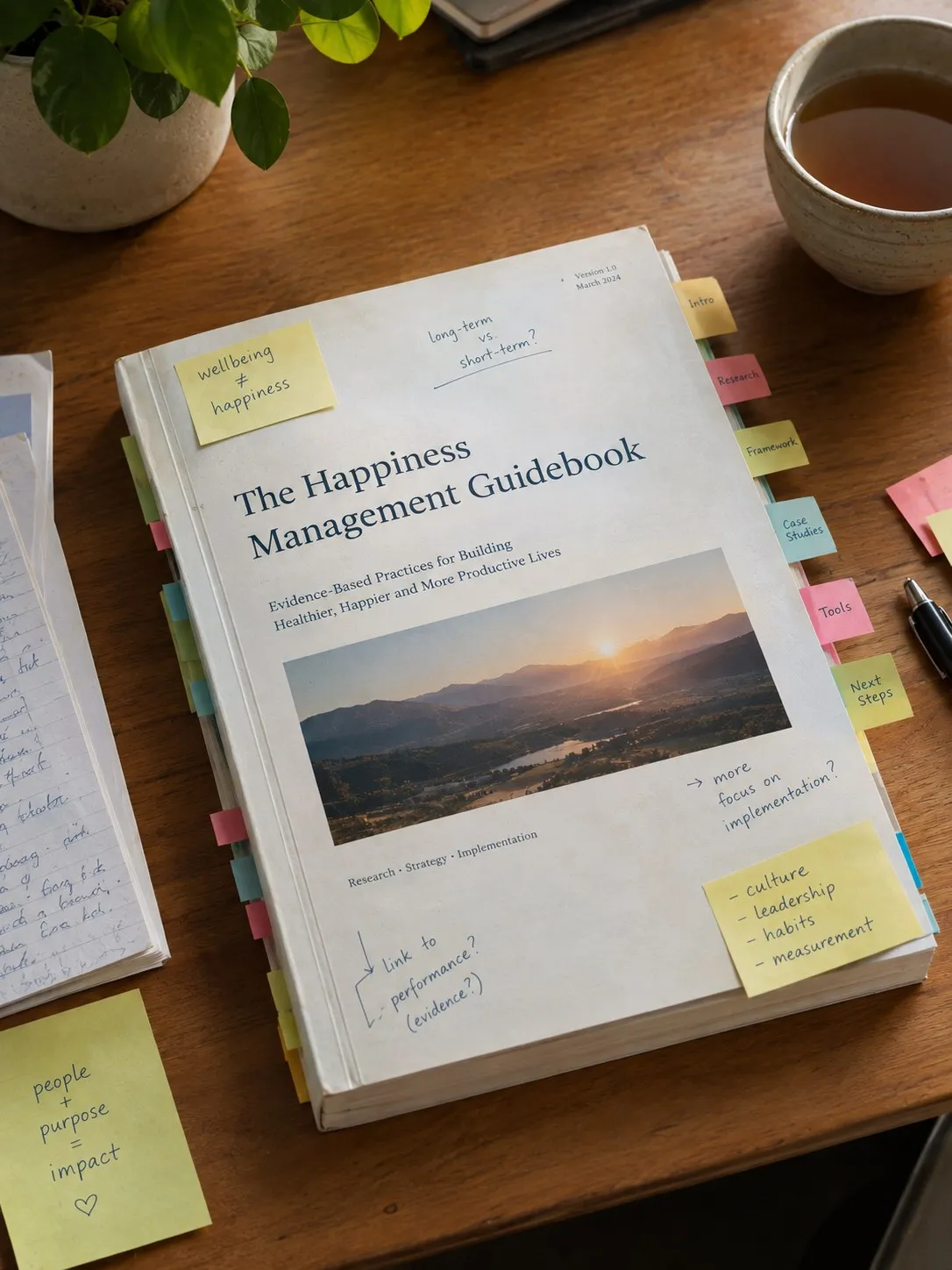
What does the book claim?
Happy employees are more engaged, productive and effective.
Abstract
My Executive MBA thesis at VŠE Prague, written as an ethnographic study rather than a survey (grade A). The claim is simple and well documented: happy employees are more engaged, productive and effective. The book is about what that takes in practice inside IT companies: professional empathy, personalised onboarding, multi-layered feedback and leaders who are present. It is now the foundation of Being Václav.
And Happiness Management is not pizza Fridays and a PlayStation. It is intentional leadership inside real rules, processes and accountability.
- What I did
- I have sat on several sides of a company, from marketing through HR to the executive table, and come back at it from outside as a consultant. I interviewed hundreds of candidates, built onboarding and feedback systems, ran the learning programme and designed the offsites. The study is what I saw while doing that work, not a project I visited for a fortnight.
- What I mapped out
- Where the friction actually sits. What drives people and what drains them. How meetings and 1:1s really work, and what a feedback system has to do before anyone believes it. And the small, cheap things that move a team further than a budget does.
Who is it for?
Anyone leading a team, or a company.
Founders, executives, team leads, managers. Anyone who is responsible for what a day at work feels like for someone else.
- You were great at your job, and now you lead a team with no guidebook for it.
- You can see someone going quiet, and you do not yet know what to do about it.
- You have run the annual review for years and it has never once told you anything you did not already know.
The study is set inside IT companies. The problems are not.
What is it like to read?
Four pages from it.
Verbatim, and shortened where a rule falls. The first is open; the others are one tap away.
What Drives and Drains IT Professionals?48–50Read this page
What Drives and Drains IT Professionals?
My experience in the IT industry, particularly within small and medium software development companies, carries a captivating allure, often amplified by the pervasive “startup culture.” This sector is widely perceived as a hub of relentless innovation with incredible growth potential, frequently championed as “the next big thing.” This atmosphere cultivates a strong sense of excitement and, for many, a compelling fear of missing out (FOMO) if they are not actively engaging in this rapid evolution. Being an integral part of this continuous “growth” serves as a significant motivation for IT professionals, offering a profound sense of purpose and a means to future-proof their careers.
We all need the money. That is given. But work goes beyond what you do to earn a paycheck. It involves personal commitment, personal satisfaction, and personal growth. Like it or not, these results – along with promotions and pay increases – are rewards for achieving results, not just doing work.
(Ekeren, 2001)
Beyond these intrinsic motivators, the tangible benefits are also substantial. IT professionals, based on the Czech salary average, typically command salaries (sometimes significantly) above this national average (Hurta, 2025), and the sector is widely regarded as offering great jobs with desirable flexibility in work arrangements. However, these very draws – the high stakes of innovation, the rapid pace, and the premium placed on constant growth – also inherently introduce unique pressures that can profoundly impact well-being, demanding a proactive approach to Happiness Management.
I would like to challenge it with another perspective. I remember vividly passing my state exam in high school, elated that it was all over. Suddenly, after years of intense study, I had over three months of “free time”—a concept that felt more strange than good. I knew I needed a new, slim, sleek laptop for university, and I had to earn it. I took a manual construction job. Working physically and enduring exhaustion, I quickly understood physical pain. You feel it immediately when your body aches and when you can’t get up. In such a state, you’re almost physically forced to quit. But IT jobs rarely bring this immediate physical pain. Instead, there’s a far more insidious “mental pain” that accumulates slowly, often unnoticed, until it manifests as profound apathy. During my professional career, I observed professionals reaching a state where they literally “did not care about the job at all.” This mental drain is a precursor to burnout, a very sensitive topic.
I have witnessed skilled professionals lose their speed and ambition due to incompetent managers, leaders, and executives. This reality, observing talented individuals lose their spark, is one of the core reasons I am writing this study. I fundamentally believe that managers should look beyond their “fancy dashboards” and into the human reality—to observe, face-to-face, that some individuals in their team are literally empty, lacking the fuel to continue the work they once loved.
However, this dynamic plays out on both sides of the table. I recall a friend, a senior manager at a well-known IT company, whose job seemingly revolved around smiling, inspiring others, and managing expectations. Everyone around her believed she was the happiest person alive, always performing brilliantly. Yet, unlike the visible physical tiredness of a manual worker, her mental exhaustion was far harder to detect. She was a consummate professional, skilled at concealing her personal issues behind her work. This ability to mask internal struggles makes it incredibly challenging for leaders to recognise when their most capable employees are on the verge of breakdown. She could only sustain this until her personal energy reserves were completely depleted.
I encourage every reader to prioritise their well-being. Acknowledge your current situation. If it feels excessively overwhelming, consider taking a break, even if it’s just for a short time. (Grant, 2023) sees it this way:
Relaxing is not a waste of time—it’s an investment in well-being. Breaks are not a distraction—they’re a chance to reset attention and incubate ideas. Play is not a frivolous activity—it’s a source of joy and a path to mastery.
- (Ekeren, 2001) Ekeren, G. V. (2001). 12 simple secrets of happiness at work: finding fulfillment, reaping rewards. Prentice Hall Press.
- (Hurta, 2025) Hurta, M. (2025, Květen 28). Kolik si vydělá ajťák v Česku? Retrieved May 25, 2025, from https://engeto.cz/blog/kariera/kolik-si-vydela-ajtak-v-cesku/
- (Grant, 2023) Grant, A. (2023). Hidden Potential: The Science of Achieving Greater Things. Penguin Publishing Group.
Implementing Happiness Management105Read this page
Implementing Happiness Management
Take a deep breath. Close your eyes. Imagine what you want to achieve. There. Now go for it.
I understand, intimately, the challenges you may be facing within your company. There could be ongoing communication issues within your team. You may not always agree with all your colleagues, and frankly, that is perfectly acceptable; perfection is rarely found in human endeavours. The vital insight lies in what you decide to do next.
It is entirely up to you how you react to these situations and how you choose to address—or not address—the challenges that arise. If you ever find yourself feeling bewildered or overwhelmed, a powerful starting point is to simply pose a question to your team: “What’s the one thing I can do better?”
From my own journey in leading people, I’ve consistently found immense value in learning from the past and consciously striving not to repeat previous mistakes. As the philosophy articulated in “The Obstacle Is the Way” (Holiday, 2014) suggests, “How you do anything is how you can do everything... we can always act right!” This chapter is dedicated to embodying that proactive spirit by providing you with practical, positive steps to implement Happiness Management, one deliberate action at a time.
Who are the happiest people on earth? A craftsman or artist whistling over a job well done. A little child building sand castles. A mother, after a busy day, bathing her baby. A doctor who has finished a difficult and dangerous operation and saved a human life. Happiness lies in a constructive job well done. Get your happiness from your work, or you will never know what happiness is.
(Schutz, 1999)
- (Grant, 2023) Grant, A. (2023). Hidden Potential: The Science of Achieving Greater Things. Penguin Publishing Group.
- (Holiday, 2014) Holiday, R. (2014). The obstacle is the way: the timeless art of turning trials into triumph. Penguin Group.
- (Schutz, 1999) Schutz, S. P. (1999). The language of happiness: A collection from Blue Mountain Arts (Second printing ed.). Blue Mountain Press.
Baby Steps106–108Read this page
Baby Steps
The title of this chapter, “Baby Steps,” was initially conceived as a temporary placeholder, something I assured my academic supervisor would, of course, be replaced with a more professional-sounding alternative. However, as I delved deeper into the practicalities of implementing Happiness Management, I realised its profound resonance and suitability. The idiom’s definition:
A very small or tentative action, process, or stage in the advancement toward some larger or more difficult goal or end.
(The Free Dictionary)
perfectly encapsulates the most effective approach to fostering well-being and engagement within any organisation. I strongly advocate that every team leader, especially those already managing an existing team, embrace this philosophy. Instead of attempting a “big reform out of the blue,” the power lies in consistently implementing smaller, incremental improvements (except in critical situations where larger actionable steps may be necessary). The continuity of these actions, no matter how small, will ultimately yield a much larger and more sustainable impact.
Crucially, focus on the things within your immediate “scope.” If you are a smaller company struggling with foundational elements of company culture, or if you possess hardly any employee benefits, it would be unrealistic to prioritise sponsoring hospital aid in developing countries. While this example is admittedly extreme, it underscores a fundamental principle: you must stabilise your own foundation first before you can effectively help others. I am reminded of my basic first aid training, which teaches precisely this: in an emergency, your primary responsibility is to ensure your own safety (e.g., from traffic on the road) before attempting to assist the injured. If you don’t survive the situation yourself, how can you possibly save someone else? This analogy applies directly to organisational well-being.
There is an overwhelming array of initiatives—ESG, sustainability, carbon neutrality, and vast investments—that companies could undertake. However, if the foundational “ground stones” of internal well-being and basic employee care are not firmly in place, these grander endeavours will not save the company and will most probably largely fail to deliver meaningful impact in the long run.
It Does Not Have to Cost a Fortune
To genuinely foster a thriving workplace, it is a common misconception that one must possess an excessively large budget filled with elaborate perks and costly initiatives. My ethnographic observations, however, have consistently revealed a powerful truth: impactful Happiness Management often requires not a significant financial outlay but rather a profound shift in mindset, coupled with consistent, intentional micro-actions. It begins with fundamental human gestures: simply smile more, say something nice, acknowledge someone for their efforts, and crucially, pay a bit more attention. These are not platitudes; they are the bedrock of authentic human connection in a professional setting, capable of initiating positive ripples throughout an organisation.
This principle of thoughtful adaptation and continuous improvement extends to even the most mundane workplace rituals. I vividly recall joining a different company and taking over a smaller team of skilled professionals. During the transition from the previous manager, I deliberately observed their existing meeting dynamics, closely watching how they interacted and what their established “way of operating” was. After a few weeks, it became clear that their long-standing, often unchanged meeting structure was proving largely ineffective. Yet, I refrained from immediate intervention. Once the transition was complete and I assumed full responsibility for leading the team and these meetings, I posed a bold, direct question: “Do you truly like the structure of this 1-hour meeting?” The response was an awkward silence, but their facial expressions spoke volumes, loudly yet without a single noise from their faces. Their expressions conveyed a sense of resignation, as if they had simply accepted this “reality” without it ever occurring to them that change was possible. I observed all the faces during that silence and discerned a glimmer of hope for change. This intuition, this ability to “read the room,” was my cue.
Equipped with this initial qualitative feedback, I created an anonymous questionnaire, gathered more detailed insights, meticulously analysed the data, and then presented a proposed new structure to the team. The response was overwhelmingly positive, with team members expressing immense relief: “Finally, we can focus on what is important and not just blindly report something you can read on the dashboard!” We collaboratively fine-tuned my proposed structure. From the very next meeting, we were able to save approximately 25 minutes, reducing the call length while simultaneously establishing a structure that made much more sense.
- (The Free Dictionary) The Free Dictionary. (n.d.). English meaning - BABY STEPS. Retrieved 06 2025, from The Free Dictionary: https://idioms.thefreedictionary.com/baby+steps
Active Listening117–118Read this page
Active Listening
True communication extends far beyond speaking; it requires active listening. This is the empathetic process of fully absorbing what another person is saying, including unspoken cues and underlying emotions. It is a vital skill for understanding implicit needs, fostering psychological safety, and building genuine trust within any team. When you give someone your full attention, you not only ensure that you receive their complete message—leading to more effective discussions and decisions—but also convey an invaluable underlying principle: “I value your time. I am here for you. I am interested in what you are saying.” This nurtures the communication channel with that person, making them feel safe and less hesitant to approach you in the future.
I’ve witnessed the negative effects of poor active listening firsthand. In our meetings, even those he arranged himself, I often saw an executive who remained perpetually distracted. His smartwatch buzzed incessantly with notifications, he checked email alerts from his computer, and he replied to calls with brief responses or text messages. I recall a one-on-one meeting where, while I was presenting an important new strategy in his office, he responded only with disinterested “mm, mmmh” nods. During a moment of silence filled solely by my voice, I calmly stated, “...so we should examine this strategic approach that could enhance our employer branding—are you even listening to me?—and basically...” He failed to acknowledge my direct inquiry. Regrettably, this was not an isolated episode but a recurring behaviour pattern. His constant distractions made it exceedingly challenging for anyone wishing to deliver an important message to him. This behavior communicates a clear message: “I do not value your input,” prompting employees to steer clear of such leaders in the future unless absolutely necessary.
Through numerous one-on-one meetings, I learned that active listening is critically important. Feedback should never be ignored; it needs to be genuinely acknowledged and carefully recorded.
(Level 2: The Power of 1:1s, p. 124)
- You might be tempted to immediately jump in or resolve the problem an employee or colleague presents. However, sometimes their primary need is simply for you to listen actively, without offering immediate solutions.
- Ask questions that genuinely invite your employee or colleague to elaborate on their thoughts and feelings. This creates an open space for them to share more deeply, ensuring you truly understand their perspective.
- Demonstrate your active listening through non-verbal cues. Maintain an open and relaxed body posture, face your employee or colleague, and nod to show you are engaged and following their message.
- If an employee or colleague expresses negative feelings, ensure that you validate their emotions. Consider their perspective and try to put yourself in their shoes to truly understand why they feel that way.
- Your primary objective is to fully grasp your employee’s or colleague’s perspective. Therefore, make a conscious effort not to interrupt with your own opinions while they are speaking, allowing them to fully express themselves.
- Always allow your employee or colleague to finish speaking completely before offering any advice. This ensures you’ve achieved a full and complete understanding of their message first.
- Once you have fully absorbed everything your employee or colleague has communicated, take a deliberate moment to evaluate the entire conversation. This pause allows for comprehensive understanding before responding or acting.
- Rephrase what your employee or colleague has said to confirm your understanding and demonstrate your full attention. This ensures you’ve accurately grasped their message and shows them they’ve been truly heard.
What now?
Which of these is happening on your team?
If any of it sounded like your week, that is the conversation. No pitch: you tell me what is going on, I tell you what I would look at first.
Twenty minutes. About as long as a bowl of matcha lasts.
Copied
JavaScript is off, so the address stays hidden from the robots. The calendar works either way: Find a time that works